Bright Side Of The Moon

Un sitio como otro cualquiera, sencillo, musical y algo paranoide... lo normal.

jueves, abril 17, 2008

Billy Joel - Storm Front


Billy Joel - Storm Front (1989)
Japan Cardboard Sleeve MHCP-550 (2008)
flac.cue.log.covers

Penultimo disco de Joel, antes del postumo "River of Dreams". Aun sin ser el mejor de su discografia, y sera por amor secular a su musica, "Storm Front" sigue la trayectoria de gran calidad que siempre a caracterizado su carrera. Realmente me gusta su forma de componer y cantar. La comprometida "We Didn´t Start The Fire", la soberbia "I Go To Extremes" o la lirica "Leningrad", sin contar la inspirada "State Of Grace". Un gran disco de Billy, que dejo la musica hace ya demasiado tiempo.

On 'Storm Front,' his first studio album since The Bridge in 1986, Billy Joel throws off pop complacency for an angry, committed – and often moving – exploration of life in modern America. Defining the album's theme of lost innocence is a core of songs that evokes the desperate disorientation that has suffused American consciousness over the past decade. Storm Front's aggressive tone is immediately established by the surging slide guitar and growling blues harp that kick off "That's Not Her Style," the record's opening track. But the album gets down to business with its second cut, "We Didn't Start the Fire."

Storm Front's propulsive first single, "We Didn't Start the Fire," sounds the alarm on a society that has lost its moral center and is spinning out of control. Telescoping forty years of history into a feverish, chronological roll call of political leaders, pop icons and world events, Joel charts the steady erosion of our national spirit since 1949 – incidentally, the year of his birth. The singer captures the carefree mood of '49 in the first of a series of musical time capsules: "Harry Truman, Doris Day, red China, Johnnie Ray/South Pacific, Walter Winchell, Joe DiMaggio." But as the song rushes toward the present, it catalogs the crises that have compromised our dreams. Ending with a spirit-crushing litany of contemporary social horrors – "Foreign debts, homeless vets, AIDS, crack, Bernie Goetz/Hypodermics on the shores, China's under martial law" – Joel shouts, "I can't take it anymore!"

The broad cultural sweep of "We Didn't Start the Fire" finds a personal focus in the record's next track, "The Downeaster 'Alexa'." The song tells a haunting tale about a Long Island fisherman who cannot provide for his family because government regulations have crippled his livelihood. With its slow, martial beat and plaintive, gull-like violin squalls, "Alexa" casts a dreamlike image of a wrecked man "trolling Atlantis," navigating a lost world. The song reaches an aching climax when, stirred by the memory of his fisherman father, the man cries aloud, lamenting the death of his family legacy. That Joel's daughter is named Alexa Ray only heightens the song's resonance.

Joel's other protagonists experience vague frustrations and longings. The character in the hard-driving "I Go to Extremes" futilely tries to account to his girlfriend for his inconsistent moods and wavering confidence. The lover in "Shameless" sings with perverse pride about his enslavement to his woman's affections, while his swaggering alter ego in "Storm Front" disowns domestic bliss and sets sail on a sea of temptation.

Not all of the weather on Storm Front is so heavy, however. Joel offers heartening assurances on "When in Rome," an uplifting, R&B-inflected anthem about love's survival. And on the stately "Leningrad," Joel chronicles how his 1987 visit to the Soviet Union melted his cold-war fears.

Musically, Storm Front struts with insistent rock & roll authority. Foreigner's Mick Jones, who coproduced the album with Joel, replaces Joel's longtime collaborator Phil Ramone; as a result, the record boasts a muscular drum sound, gritty guitar work and some rousing blues-rock whomp. The producers steer clear of the Joel-Ramone penchant for epic suites and stylistic pastiche in service to Storm Front's sturdy rock & roll heart.

In dramatic fashion, Joel provides the otherwise tempestuous Storm Front with a coda of exquisite grace. The hymnlike "And So It Goes" takes the record's turbulent emotions and stills them in a moment of quiet revelation. Accompanied only by a piano and a discreet synthesizer, Joel proposes emotional vulnerability and reconciliation to life's uncertainties as a route to secular redemption. It is a note of startling maturity, at once mournful and bracing. And as the final word on an album that takes a serious look at a troubled world, it reflects the hard-earned wisdom of a no longer innocent man. (RS 566) Rolling Stone

  1. "That's Not Her Style" – 5:10
  2. "We Didn't Start the Fire" – 4:50
  3. "The Downeaster "Alexa"" – 3:44
  4. "I Go to Extremes" – 4:23
  5. "Shameless" – 4:26
  6. "Storm Front" – 5:17
  7. "Leningrad" – 4:06
  8. "State of Grace" – 4:30
  9. "When In Rome" – 4:50
  10. "And So It Goes" – 3:38

Etiquetas:

lunes, abril 07, 2008

Jefferson Airplane - Surrealistic Pillow - Japan Mini LP Replica


Jefferson Airplane - Surrealistic Pillow
Japan Carboard Sleeve BVCM - 37625
Mini LP Replica
flac.cue.log.covers

Esto si que es un autentico lujo. El mejor disco de la Jefferson en una edición que suena como los angeles y con unos bonus muy interesantes, incluida una toma de "Go To Her" una cancion puro Airplane psicodelico.

Surrealistic Pillow is an album by American psychedelic band Jefferson Airplane, released in February of 1967. Original drummer Alexander ‘Skip’ Spence had left the band in mid-1966, replaced by a jazz drummer from Los Angeles, Spencer Dryden. Singer Signe Toly Anderson departed soon after, and by the Fall of 1966 the group hired new singer Grace Slick, who brought from her previous band The Great Society the two songs that would become the Airplane’s biggest Top 40 hits, “White Rabbit” and “Somebody to Love,” the latter composed by her then-brother-in-law. Both Slick and Dryden debuted with the band on records with this album and its attendant singles, thus completing the best-known line-up of the group, which would remain stable until Dryden’s departure in 1970. It’s also considered to be one of the quintessential albums of the counterculture movement/social revolution.

Jefferson Airplane’s fusion of folk rock and psychedelia was original at the time, in line with musical developments pioneered by The Byrds, The Mamas & the Papas, and Bob Dylan. Surrealistic Pillow was the first blockbuster psychedelic album by a band from San Francisco, announcing to the world the active bohemian scene that had developed there starting with The Beats during the 1950s, extending and changing through the 1960s into the Haight-Ashbury counterculture. Subsequently, the exposure generated by the Airplane and others wrought great changes to that counterculture, and by 1968 the ensuing national media attention had precipitated a very different San Francisco scene than had existed in 1966. San Francisco photographer, Herb Greene photographed the band for the album’s cover art.

Some controversy exists as to the role of Grateful Dead guitarist Jerry Garcia in the making of the album. His reputed presence on several tracks is not corroborated by RCA paperwork and is denied by producer Rick Jarrard. But when performing Comin’ Back to Me live with Jefferson Starship, Marty Balin almost always introduced the song with a reference to the Surrealistic Pillow sessions, mentioning Garcia as playing the guitar parts on the original studio version.

Surrealistic Pillow was originally released as RCA Victor LPM/LSP 3766, and peaked at #3 on Billboard’s Pop Albums chart, driven by “White Rabbit” and “Somebody to Love,” which peaked at #8 and #5 respectively on the Billboard Hot 100 chart. The album was mixed in both mono and stereo, and both mixes are available on a November 2001 reissue, initially as part of the Ignition box set; another stereo reissue appeared on August 19, 2003, with seven bonus tracks, including the mono A-sides of “Somebody to Love” and “White Rabbit.” The 2003 reissue was produced by Bob Irwin.

In 2003, the album was ranked number 146 on Rolling Stone magazine’s list of the 500 greatest albums of all time. Wikipedia

The second album by Jefferson Airplane, Surrealistic Pillow was a groundbreaking piece of folk-rock-based psychedelia, and it hit — literally — like a shot heard round the world; where the later efforts from bands like the Grateful Dead, Quicksilver Messenger Service, and especially, the Charlatans, were initially not too much more than cult successes, Surrealistic Pillow rode the pop charts for most of 1967, soaring into that rarefied Top Five region occupied by the likes of the Beatles, the Rolling Stones, and so on, to which few American rock acts apart from the Byrds had been able to lay claim since 1964. And decades later the album still comes off as strong as any of those artists’ best work. From the Top Ten singles “White Rabbit” and “Somebody to Love” to the sublime “Embryonic Journey,” the sensibilities are fierce, the material manages to be both melodic and complex (and it rocks, too), and the performances, sparked by new member Grace Slick on most of the lead vocals, are inspired, helped along by Jerry Garcia (serving as spiritual and musical advisor and sometimes guitarist). Every song is a perfectly cut diamond, too perfect in the eyes of the bandmembers, who felt that following the direction of producer Rick Jarrard and working within three- and four-minute running times, and delivering carefully sung accompaniments and succinct solos, resulted in a record that didn’t represent their real sound. Regardless, they did wonderful things with the music within that framework, and the only pity is that RCA didn’t record for official release any of the group’s shows from the same era, when this material made up the bulk of their repertory. That way the live versions, with the band’s creativity unrestricted, could be compared and contrasted with the record. The songwriting was spread around between Marty Balin, Slick, Paul Kantner, and Jorma Kaukonen, and Slick and Balin (who never had a prettier song than “Today,” which he’d actually written for Tony Bennett) shared the vocals; the whole album was resplendent in a happy balance of all of these creative elements, before excessive experimentation (musical and chemical) began affecting the band’s ability to do a straightforward song. The group never made a better album, and few artists from the era ever did.

[Surrealistic Pillow on CD has been problematic — actually, make that a real pain in the ass. It’s been reissued numerous times on compact disc, in distinctly different editions — a plain 11-song disc from the 1980s that sounded wretched and was an embarrassment; a high-priced RCA-BMG gold-disc upgrade, with significantly better sound from the mid-’90s that encompassed the stereo and mono mixes of the album; a European version from 2000/2001 (with four bonus tracks but no mono mix or liner notes) that got into the U.S. as an import; a U.S.-issued 2001 upgrade, initially available in the bizarre four-CD box Ignition, which encompassed the stereo and mono mixes in a brighter, sharper, louder remastering than the 1996 version, but still — in some listeners’ eyes — lacking the presence and the soaring sound of the original LP; and a 2003 reissue (on the BMG Heritage label), mastered by renowned reissue producer Bob Irwin (of Sundazed Records fame), including the mono single versions of “White Rabbit” and “Somebody to Love,” along with the related bonus tracks “Come Back Baby,” “In the Morning,” “J.P.P. McStep B. Blues,” and “Go to Her,” which have previously been scattered around various anthologies and other expanded editions. Those tracks generally push Kaukonen even more to the fore and give the balance of the material a bluesier feel. And there’s an uncredited “hidden” bonus cut, an instrumental of “D.C.B.A. - 25.”] AllMusicGuide


1. “She Has Funny Cars” (Marty Balin / Jorma Kaukonen) – 3:12
2. “Somebody to Love” (Darby Slick / Grace Slick) – 2:58
3. “My Best Friend” (Skip Spence) – 3:01
4. “Today” (Marty Balin / Paul Kantner) – 2:59
5. “Comin’ Back to Me” (Marty Balin) – 5:18
6. “3/5 of a Mile in 10 Seconds” (Marty Balin) – 3:41
7. “D.C.B.A. -25″ (Paul Kantner) – 2:37
8. “How Do You Feel” (Tom Mastin) – 3:31
9. “Embryonic Journey” (Jorma Kaukonen) – 1:53
10. “White Rabbit” (Grace Slick) – 2:30
11. “Plastic Fantastic Lover” (Marty Balin) – 2:37
12. “In the Morning” (Kaukonen) – 6:21
13. “J.P.P. McStep B. Blues” (Spence) – 2:37
14. “Go To Her (version two)” (Kantner, Irving Estes) – 4:02
15. “Come Back Baby” (trad. arranged Kaukonen) – 2:56
16. “Somebody to Love” (mono Single mix) (D. Slick) – 2:58
17. “White Rabbit” (mono Single mix) (G. Slick) – 2:31
18. “D.C.B.A. -25″ (Kantner) (instrumental - hidden track) – 2:39

Enlace en comentarios / Link in comments


Etiquetas: ,

lunes, marzo 31, 2008

Keith Richards – Talk is Cheap (MFSL)


Keith Richards - Talk is Chip (1988)
MFSL UDCD 557 (1992)
wv.covers.cue.log


Talk Is Cheap is the solo album debut by Keith Richards, co-leader of The Rolling Stones, and was released in 1988. Recorded and released following a brief creative and personal fallout with Mick Jagger, Talk Is Cheap received glowing reviews upon its release.
Relations between Jagger and Richards had grown tense over the course of the 1980s, as they began to differ on the musical direction of their famous band. The image-conscious Jagger was keen to follow the trends and keep The Rolling Stones current, while Richards wanted to preserve their reputation and roots. When Jagger was more interested in pursuing his solo career instead of touring for Dirty Work in 1986, Richards was stung by Jagger's move and began contemplating a solo project for the first time.
Teaming up with Steve Jordan, who had worked on Dirty Work, the pair wrote several new songs (one of which, "Almost Hear You Sigh", would be placed on The Rolling Stones' Steel Wheels in 1989 with lyrical modifications by Jagger). Recording began in August 1987 in Montreal and continued sporadically until the following May with visits to Montserrat. In order to assert his independence further, Richards would sign with Virgin Records, while The Rolling Stones were currently under contract with Sony Music (although they'd switch over to Virgin themselves in 1991).
Of the friends and celebrities taking part, including Ivan Neville, Sarah Dash and Patti Scialfa, the most famous is former guitarist for The Rolling Stones, Mick Taylor.
The songs recorded for Talk Is Cheap find Richards in a confident and carefree mood, with a very natural air to the precedings. The only moment where the setting turns somewhat heated is in "You Don't Move Me", a thinly-veiled response to Jagger that was well-publicised by the media upon the album's unveiling.
Released in October 1988, Talk Is Cheap was released to a very receptive critical reaction (many reviewers jokingly called it the best Rolling Stones album in years) and it peaked at #37 in the UK and #24 in the US, where it went gold.


01. Big Enough
02. Take It So Hard
03. Struggle
04. I Could Have Stood You Up
05. Make No Mistake
06. You Don't Move Me
07. How I Wish
08. Rockawhile
09. Whip It Up
10. Locked Away
11. It Means a Lot


Keith Richards Dead Flowers live


Enlace en comentarios / Link in comments

Etiquetas:

jueves, marzo 27, 2008

Jefferson Airplane - Volunteers (MFSL)

Jefferson Airplane - Volunteers (MFSL UDCD 540)
wv.scans

Autenticos precursores de la psicodelia de la costa oeste, la Jefferson junto a Grateful Dead son las megabandas mas importantes del movimiento hippie de los 60. Comenzaron con un disco de onda folk rock, incluso en su mejor disco, "Surrealistic Pillow", a mas gloria de Marty Balin la psicodelia se combina con temas mas acusticos y liricos. En 1969, en plena guerra de Vietnam, "Volunteers" podria ser el ultimo disco de una era hippie que estaba moribunda, ademas de ser el disco postumo de la Jefferson como gran banda, ya que los posterioes "Bark" y "Long John Silver" bajan bastante en cuanto a calidad se refiere. Aqui colaboraron Garcia, Stills, Hopkins... Un gran disco con canciones memorables y una carga social de mucha enjundia.

Controversial at the time, delayed because of fights with the record company over lyrical content and the original title (Volunteers of America), Volunteers was a powerful release that neatly closed out and wrapped up the '60s. Here, the Jefferson Airplane presents itself in full revolutionary rhetoric, issuing a call to "tear down the walls" and "get it on together." "We Can Be Together" and "Volunteers" bookend the album, offering musical variations on the same chord progression and lyrical variations on the same theme. Between these politically charged rock anthems, the band offers a mix of words and music that reflect the competing ideals of simplicity and getting "back to the earth," and overthrowing greed and exploitation through political activism, adding a healthy dollop of psychedelic sci-fi for texture. Guitarist Jorma Kaukonen's beautiful arrangement of the traditional "Good Shepherd" is a standout here, and Jerry Garcia's pedal steel guitar gives "The Farm" an appropriately rural feel. The band's version of "Wooden Ships" is much more eerie than that released earlier in the year by Crosby, Stills & Nash. Oblique psychedelia is offered here via Grace Slick's "Hey Frederick" and ecologically tinged "Eskimo Blue Day." Drummer Spencer Dryden gives an inside look at the state of the band in the country singalong "A Song for All Seasons."

The musical arrangements here are quite potent. Nicky Hopkins' distinctive piano highlights a number of tracks, and Kaukonen's razor-toned lead guitar is the recording's unifying force, blazing through the mix, giving the album its distinctive sound. Although the political bent of the lyrics may seem dated to some, listening to Volunteers is like opening a time capsule on the end of an era, a time when young people still believed music had the power to change the world. Volunteers was reissued in late 2001 by BMG Records' Spanish division in a crisply remastered edition containing 30 minutes of outtakes, which consist mostly of early versions, usually with very different lead guitar -- often a lot louder -- and vocal parts, of "Wooden Ships," "Volunteers," "We Can Be Together," "Turn My Life Down," "Good Shepherd," and "Hey Frederick." Some of these are very different from their official released versions and all are certain to please fans of Jorma Kaukonen, whose electric playing is heavily showcased on all of them.

Volunteers

Mire lo que esta pasando en las calles
Tiene una revolución llegué a la revolución
Hey estoy bailando por las calles
Tiene una revolución llegué a la revolución
No es sorprendente que todas las personas que cumplen y
Tiene una revolución llegué a la revolución
Obtuvo una generación de edad
Una generación con alma
Esta generación no tienen destino para celebrar
Recoger el grito
Hey ahora es el momento para que usted y yo
Tiene una revolución llegué a la revolución
Venid ahora estamos marchando al mar
Tiene una revolución llegué a la revolución
Que tendrá de ti
Nosotros y quienes somos
Somos voluntarios de América


Enlace en comentarios / Link in comments


Etiquetas: ,

lunes, marzo 24, 2008

Humble Pie - Rock On (MFSL)


Humble Pie - Rock On
MFSL Aluminum (MFCD 847)
wv.scans


This is the final studio album to feature guitarist and vocalist Peter Frampton, Rock On saw Humble Pie establishing the heavy blues/rock sound they became famous for, led in no small part by their new manager, American, Dee Anthony after the collapse of Andrew Loog Oldham's Immediate Records. But this was not where Frampton wanted to be and within a year he had quit the group to pursue his solo career and take his music in a more acoustic direction.

Rock On cut its teeth live before it was recorded, with the band just finishing an American tour. Marriott considered the album like a studio party featuring numerous guest performers from the world of blues and soul. Distinguished performers such as PP Arnold, who Marriott knew very well from his Small Faces days, Doris Troy who had a U.S. hit in the early 1960s with her own self-composed song "Just One Look" (later covered by The Hollies), and Claudia Lennear (who had sung backing for artists such as Joe Cocker, Freddie King and Gene Clark), were featured on this album.

The album features the classic rock song "Stone Cold Fever" written by band members Marriott, Ridley, Frampton and Shirley. Steve Marriott's ballad "A Song For Jenny" (written for first wife Jenny Rylance) features The Soul Sisters (Doris Troy, P.P. Arnold and Claudia Lennear) on backing vocals. B.J. Cole contributes pedal steel guitar. "Strange Days" is a ballsy blues rock song, as Marriott's powerful vocals soar the closest to a live performance that any on this album reach, it is also the longest song on the album too, the vocals having a delayed echo making it all the more out there yet grounded especially Frampton's guitar solos that weave throughout. "Sour Grain" was a joint composition by Peter Frampton and Steve Marriott, which keeps the same tempo as "Shine On", but with just Steve on vocals.

1. Shine On Listen Listen
2. Sour Grain Listen Listen
3. 79th And Sunset Listen Listen
4. Stone Cold Fever Listen Listen
5. Rollin' Stone Listen Listen
6. A Song For Jenny Listen Listen
7. The Light Listen Listen
8. Big George Listen Listen
9. Strange Days Listen Listen
10. Red Neck Jump Listen Listen


Humble Pie - I Don't Need No Doctor - 1971


Enlace en comentarios / Link in comments

Etiquetas:

jueves, marzo 20, 2008

Van Halen I (1979) + Fair Warning (1981) HDCD


Van Halen I (1979)
HDCD Remastered 2000
ape.log.cue.covers

Van Halen es una banda estadounidense de hard rock y heavy metal, llamada así por los hermanos Eddie Van Halen y Alex Van Halen (Guitarra y batería respectivamente).

El primer álbum de la banda, Van Halen de (1978) es ampliamente considerado como un hito en la historia del rock. Con este primer estreno, la banda se estableció como un líder en el emergente y desafiante mundo hard rock de los EE.UU. En particular, el guitarrista de la banda, Eddie Van Halen, extendió rápidamente su fama gracias a su técnica y sensibilidad musical. Hoy en día es considerado como uno de los guitarristas de rock más innovadores e influyentes.

De 1978 a 1998 la banda editó 11 álbumes (todos ellos estuvieron entre los 20 mejores de Billboard). La banda ha vendido más de 75 millones de álbumes mundialmente y ha recibido varias nominaciones a los premios Grammy, ganando uno con el álbum "For Unlawful Carnal Knowledge" en 1991. Van Halen se lista en el Libro Guinness de los Récords con la mayor cantidad de Nº 1's en la lista de rock de Billboard. Según la Asociación de la industria discográfica de Estados Unidos, Van Halen es Nº 19 en la lista los artistas que más han vendido jamás (habiendo vendido más de 56 millones de álbumes en EE.UU.).

Van Halen es el álbum debut del grupo americano de Hard Rock Van Halen, lanzado en 1978. Aunque el disco se encuentra entre los 20 más vendidos en los años 1970, con más de 10 millones de copias vendidas, no pasó del puesto 19 en las listas de éxitos de su país durante su lanzamiento, ni del 34 en el Reino Unido. Pese a que el disco suena como si fuera en directo es un disco de estudio en el que el productor, Ted Templeman introdujo ecos y efectos añadidos que le dan contundencia. Durante la grabación se usó una técnica entonces novedosa para los solos: el tapping, que consiste en usar ambas manos en el mástil de la guitarra, técnica inventada por Eddie Van Halen, que durante la promoción del disco tocaba los solos de espaldas al público para esconder su técnica.

Los Temas:
1. Runnin With the Devil (3:36)
2. Eruption (1:42)
3. You Really Got Me (Ray Davies) (2:37)
4. Ain't Talkin' 'Bout Love (3:49)
5. I'm the One (3:46)
6. Jamie's Cryin' (3:30)
7. Atomic Punk (3:01)
8. Feel Your Love Tonight (3:42)
9. Little Dreamer (3:22)
10. Ice Cream Man (John Brim) (3:19)
11. On Fire (3:00)

Los Musicos:
* Michael Anthony, Bajo, coros
* Alex Van Halen, Batería y percusiones,
* Edward Van Halen, Guitarra, coros
* David Lee Roth, Vocalista


Van Halen - Fair Warning (1981)
HDCD Remeastered 2000
ape.log.cue.covers

Es curioso que sus primeros seis álbumes de estudio, con David Lee Roth en la voz principal, creo que ninguno de estos supera los 35 minutos de duración; “Fair Warning” es el más corto: Escasamente 31 minutos y es el que más rockea. Pareciera que eran en exceso selectivos con el material que iban a entregar a sus fans en un disco, ¿o se quedaban cortos y apenas lograban sacar lo suficiente?? En todo caso lo que quedo de esos años permanecerá en el tiempo en vez de esos temas de relleno que cantidad de bandas proporcionan en sus discos, desperdiciando minutos que en muchas ocasiones si los ignorarán alcanzarían a producir un gran álbum.

Fair Warning is the fourth studio album by American hard rock band Van Halen, released in 1981. Fair Warning only went 2x platinum,[1] making it the least successful album of the David Lee Roth years. The album featured a much more adventurous and progressive sound than most of their other albums, which may have been the cause of its lackluster sales. Also, unlike the previous 'party albums' the band released, this had a darker more brooding approach.

Los Temas:
1. Mean Street
2. 'Dirty Movies'
3. Sinner's Swing!
4. Hear About It Later
5. Unchained
6. Push Comes To Shove
7. So This Is Love?
8. Sunday Afternoon In The Park
9. One Foot Out The Door

Los Musicos:
* David Lee Roth - vocals
* Eddie Van Halen - guitar
* Michael Anthony - bass
* Alex Van Halen - drums

Enlaces en comentarios / Links in comments


Etiquetas:

miércoles, marzo 19, 2008

Bee Gees - Trafalgar (MFSL)


BEE GEES

Trafalgar (MFSL UDCD 680)

1971.wv.scans.cue.log

Seguimos con algunos discos encontrados en la red y que no estan el la mula. Espero ir de compras dentro de unos dias para poner mas material original.

Los Bee Gees no han sido santos de mi devocion, salvo algunos de sus primeros lps. Tengo casi toda la discografia en vinilo, encontrada hace años en el rastro de Barcelona, una ganga. De entre ellos, "Idea", "Cucumber Castle" y este "Trafalgar" son algunos de los que mas me gustaron.

Aunque los Bee Gees son sinónimo de musica disco toda su carrera han interpretado el rock mas elaborado, de hecho son los principales exponentes de la balada soft rock. 35 años cimentaron una de las trayectorias más importantes de la música rock, de hecho ese reconocimiento fue coronado cuando ingresaron en 1997 al salón de la fama del rock mundial.
Barry Gibb nació en septiembre de 1946 en la Isla de Man (Inglaterra), segundo hijo (primero fue Lesley) del matrimonio compuesto por Hugh y Barbara Gibb, el primero un prominente baterista de su época. De ahí tal vez parte su gusto por la música. Barry no tuvo que esperar mucho para recibir a los que serían los demás miembros de su grupo, pasaron 3 años y nacieron el 22 de diciembre de 1949 los gemelos Robin Gibb y Maurice Gibb (con 38 minutos de diferencia), sus hermanos con los que formaría en un corto futuro el grupo que se lanzaría a la fama en un programa de televisión de Inglaterra cuando Barry tenía 9 años y los gemelos 6. A partir de ahí todo fue éxito. Mientras recibían la influencia total de los Beatles, los hermanos Gibb pensaron en un nombre que los inmortalizara, y que no fuera fácil de olvidar. Y fue hasta que Barry en una presentación decidió abreviar el nombre de “Brothers Gibb” "Barbara Gibb" y otras coincidencias que iniciaban con las letras iniciales B y G.

En inglés entonces serían los Bee Gees y utilizarían ese nombre para todas sus presentaciones posteriores. Iniciaron los tres hermanos con éxitos como “Cherry Red”, o Spicks and Specks” que tuvieron mucho éxito con los jóvenes de su época, pero aún no encontraban el apoyo de una disquera. Hasta que el productor Robert Stigwood captó el talento del trío y los convocó a grabar un demo junto con los músicos Vince Molonely y Colin Peterson.

El resultado fue muy favorable, y después de casi 60 canciones diferentes, los Bee Gees grababan su primer disco “oficial” (aunque ya contaban con dos producciones no comerciales tituladas Barry Gibb and the Bee Gees y Spicks and Specks) que llevó por nombre Bee Gees First y que salió en el año de 1967 y teniendo como integrantes a Barry Gibb, Robin Gibb, Maurice Gibb, Vince Molonely y Colin Peterson, de ese disco destaca sin lugar a dudas una de las melodías que ha sido reconocida por artistas de todos los idiomas a través de “covers”: “To love somebody”. Un año después y con una marcada influencia “beatle” sacaron al mercado el LP titulado Horizontal en el que se destaca el gran talento individual de Robin en cuanto a la interpretación, ya que se consagra con sencillos como “And the sun will shine” y “Massachusetts”.

Con su tercera producción “Idea” los hermanos Gibb le mostraron al mundo que estaban para algo más grande, mostraron su capacidad de interpretar varios géneros musicales entre los que destacan la balada pop, la balada rock, el rock y el country rock. De hecho quien adquiere este disco puede disfrutar de una de las canciones de mayor éxito en la historia de la música “I started a joke” (Yo comencé la broma).

Aquí empezaron los problemas, porque Vince y Colin no se sentían parte del grupo porque todas las decisiones importantes las tomaban únicamente los hermanos, es decir dos de ellos, porque Maurice se preocupaba más por los arreglos musicales que por determinar quién cantaba el siguiente “éxito”.

Fue así como después de “Idea” Barry y Robin se empezaban a distanciar porque cada uno se autonombraba líder de los Bee Gees.

Para el cuarto album (que fue doble) “Odessa” no se pusieron de acuerdo para determinar cual era el primer sencillo que iban a sacar al mercado, la lucha era entre “Lamplight” de Robin o “First of May” de Barry, finalmente fue esta última la que “ganó”.

Robin molesto por la decisión decidió abandonar a sus hermanos y determinó hacer su propia carrera como solista, fue así como sacó al mercado su primer album como solista en 1970 llamado “Robin's Reign” que tuvo mucha aceptación en Europa sobre todo con el sencillo llamado “Saved by the bell”, también tuvo un intento fallido con el disco "Sing Slowly Sisters".

Mientras Robin triunfaba, Barry y Maurice hicieron una serie de televisión que llevó el nombre de Cucumber Castle y que les inspiró para su próximo disco (sin Robin, Colin y Vince) que llevaría el mismo nombre. Casualmente los dos hermanos querían seguir la agrupación con Robin y le enviaron un mensaje con este disco, ya que el Robin's Reign de Robin y el Cucumber Castle de Barry y Maurice hacían alusión a la realeza y en sus respectivas portadas y los tres salieron disfrazados de personajes de la edad media.

Poco después se dio lo inevitable Robin regresó y crearon el quinto disco que para muchos es una obra de arte “Two years on” en el que se nota el gusto de los tres por volver a estar juntos, en este LP destacó la melodía Lonely Days que aún tocan en sus conciertos. El título de este acetato se da por la separación de los hermanos durante dos años (1969-71).

El mismo año del rencuentro sacaron al mercado el disco "Trafalgar", que para muchos es la obra cumbre de los Gibb en lo que corresponde a la balada rock. En este disco se pueden disfrutar temas como “How can you mend a broken heart” y “Dearest”.


1. "How Can You Mend a Broken Heart?" (Barry Gibb/Robin Gibb) – 3:58
2. "Israel" (B. Gibb) – 3:44
3. "The Greatest Man in the World" (B. Gibb) – 4:17
4. "It's Just the Way" (Maurice Gibb) – 2:33
5. "Remembering" (B. Gibb/R. Gibb) – 4:01
6. "Somebody Stop the Music" (B. Gibb/M. Gibb) – 3:31
7. "Trafalgar" (M. Gibb) – 3:53
8. "Don't Wanna Live Inside Myself" (B. Gibb) – 5:24
9. "When Do I" (B. Gibb/R. Gibb) – 3:57
10. "Dearest" (B. Gibb/R. Gibb) – 3:52
11. "Lion in Winter" (B. Gibb/R. Gibb) – 3:59
12. "Walking Back to Waterloo" (B. Gibb/M. Gibb/R. Gibb) – 3:51

Enlace en comentarios/Link in comments


Etiquetas:

viernes, marzo 14, 2008

Emerson, Lake & Palmer: "Pictures At An Exhibition" (K2HD)


"K2High Definition" New Remastering 1971 Island Album
ape.cue.scans.no log 1971 (2005) Victor 63173

ELP, junto a Pink Floys, Yes y Genesis (mis favoritos) son los representantes mas genuinos del prog rock de final de los 60 y los 70. Emerson que venia de "The Nice", Palmer de "Atomic Rooster" y Lake de los "King Crimson", a falta del J. Hendrix, que en su momento iba a formar parte del supergrupo, proyecto que se frustro por su muerte en 1970, formaron un grupo que fue denominado de "superinstrumentistas" por la calidad de sus tres miembros. Hicieron 5 discos magistrales, y este "Pictures" basado en la obra clasica de Modesto Mussorgsky, es uno de sus grandes discos. En el momento de escribir esto, estoy disfrutando de la ultima pieza, "Nutroker", de el cascanueces de Tchaikovsky al que cambiaron el nombre, y en cuyas manos se convierte en un sublime R&R.


Emerson, Lake & Palmer perform Mussorgsky's "Pictures At An Exhibition". Emerson, Lake & Palmer: Keith Emerson (keyboards); Greg Lake (vocals, guitar, bass); Carl Palmer (drums, percussion). 2005 Japanese import edition, this features K2 High Definition encoding and paper sleeve of original artwork. CD comes in Jpn LP Sleeve. Much was made of early prog-rock's fusion of rock with classical music, but ELP was one of the only bands to take that task seriously, and never more so than on PICTURES AT AN EXHIBITION. The well-known Mussorgsky piece is a staple of the classical music diet, and a prime example of "program music," where related sections of a piece combine to tell a story. True to the spirit of the times, ELP attacked "Pictures" with both classically trained respect and rocker irreverence. The album, recorded live in 1971, finds the band turning Mussorgsky's work inside out, not just restructuring it but reinventing it for their rock audience. While sections like "Promenade" and The Hut of Baba Yag...

1. Promenade 2. Gnome 3. Promenade 4. Sage 5. Old Castle 6. Blues Variation 7. Promenade 8. Hut Of Baba Yaga 9. Curse Of Baba Yaga 10. Hut Of Baba Yaga 11. Great Gates Of Kiev the End 12. Nut Rocker

Enlace en comentarios/Link in comments

Etiquetas:

miércoles, marzo 12, 2008

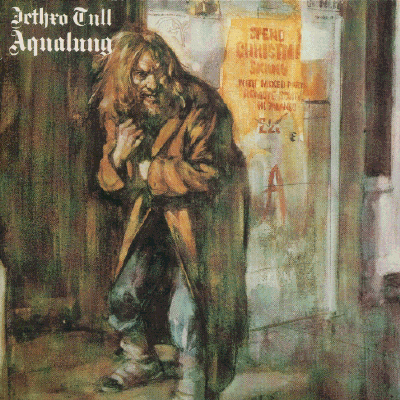
Jethro Tull - Aqualung (DCC 24 Karat Gold)


Jethro Tull - Aqualung
DCC 24 KARAT GOLD (GZS 1105) 1997
flac.scans.cue


" Aqualung," to many, is Tull's masterpiece. The title track and "Locomotive Breath," with their catchy riffs, would be joined by "My God," "Cross-Eyed Mary," and "Hymn 43" as classic rock staples. There's no arguing with its commercial success, having sold more than seven million copies and continuing to outsell anything in the back catalog.

Yet, "Aqualung" is arguably Tull's most misunderstood album. Critics dubbed it a concept album, particularly for Anderson's critical, skeptical views of organized religion, mostly on side B ("My God"). Anderson has disputed, almost resented, the assessment seeing the record as "just a bunch of songs." The labeling lead the band to really give the critics a concept album with the following studio release "Thick as a Brick."

"Aqualung" has a dominant theme but is certainly more, much more, than a concept album hindging on a solitary subject. Anderson explores the struggles of the less fortunate in our society (e.g., "Aqualung," "Cross-Eyed Mary," "Up to Me"), teenage angst and formal education difficulties ( e.g., "Wind Up," "Mother Goose"), and returns to his parental themes with "Cheap Day Return, a tune encompassing Anderson's feelings while traveling to visit his sick father.

"Aqualung" also cemented the exaggerated image, especially to those only casually acquainted with the band, that Tull was a "heavy rock" group. Years later, a Grammy for best heavy metal album (viz., "Crest of a Knave") would officially sanction the misconceived stereotype. Yet, "Aqualung" is where Anderson really begins to develop his personal style for acoustical guitar songs with "Cheap Day Return," "Mother Goose," and "Slipstream."

"Aqualung" did establish one of the most notable features of Tull's music: songs varying with intensity, mixing medium to heavy electrical sounds with lighter acoustical passages (e.g., "Aqualung," and "My God"). Indeed, every album up to "Under Wraps" (1984) would have at least one such styled number.

At the end of a brief U.S. tour, drummer Clive Bunker left to get married and form a band called "Jude" with Robin Trower. Anderson recruited Barriemore Barlow. Barlow remained drummer for the next eight years.

Ian Anderson - flute, acoustic guitar, vocals
Martin Barre - electric guitar and descant recorder
Clive Bunker - percussion
John Evan - piano, organ, mellotron
Jeffrey Hammond - bass guitar, alto recorder, and odd voices

Released: 1971
Remastered special edition (extra tracks), 1996; DCC Gold Disc 1997


"Aqualung" es un disco sumamente especial dentro de la trayectoria de Ian ANDERSON y cía.; es que fue a partir de aquí que JETHRO TULL declaró oficialmente su ingreso decidido y definitivo en la vertiente progresiva de la escena rock. Aunque no se trata, estrictamente hablando, de un concept-disc, de todos modos es inocultable la presencia de temas recurrentes en las líricas, como son los retratos de personajes marginales (vagabundos con inclinaciones pedofílicas, prostitutas infantiles, incorregibles feligreses de cantina) y la sátira social contra las contradicciones e hipocresías de la moral religiosa institucionalizada (las diatribas desenfadadas que ANDERSON arroja en 'My God' y 'Hymn 43' son tan elocuentes como sus más ponderadas reflexiones en 'Wind up'). Con la entrada del viejo amigo Jeffrey HAMMOND-HAMMOND en el bajo y la reafirmación de John EVAN (a la sazón, otro viejo amigo) en su rol de teclista, el quinteto logró reforzar la tendencia rockera de su oferta musical - incluso se nota un entusiasmo más explosivo que el vertido en el trabajo anterior, "Benefit". Pero mientras esta fuerza rockera sazonada de blues y folk seguía conformando el núcleo sonoro de JETHRO, era evidente la presencia de una mayor dosis de elaboración poética y penetración intelectual en las letras - incluso un encabezado de la revista 'Disc & Music Echo' señalaba, con relación a "Aqualung": "Por todos los cielos, ¡ahora Ian ANDERSON quiere hacernos pensar!".

La pieza homónima de apertura es uno de los clásicos indiscutibles de la historia total de JT, incluyendo uno de los solos de guitarra prototípicos de BARRE. 'Cross-eyed Mary' y 'Locomotive breath' son otras canciones que han superado largamente la prueba del tiempo con la misma frescura como si hubiesen sido grabadas hace un par de meses - estos tres temas aun son huéspedes infaltables de los setlists en vivo del grupo, y ciertamente encarnan muy bien la faceta rockera de este disco, sin caer dentro del formato rock vulgar. Las aristas progresivas aparecen más desarrolladas en los temas más extensos, 'My God' y 'Wind up'. El primero de estos es el más brillante del disco. Todas sus secciones son excelentes: la meditativa introducción de guitarra acústica, el atractivo motivo principal sobre un compás de corte bluesero, el incendiario solo de flauta en el interludio, las capas corales múltiples (cortesía de HAMMOND-HAMMOND) que emergen durante la parte final del solo de flauta. 'Wind up', por su parte, sigue una senda menos épica, mas funciona como un perfecto corolario del disco: la razón de ello es que condensa en sí el espíritu del folk, la garra del rock y la complejidad estructural del prog en dosis equilibradas, como si se tratara de una recapitulación sumaria del repertorio precedente. La sensibilidad bucólica de ANDERSON rinde buenos frutos en las tres baladas acústicas (los temas 3, 5 y 9), así como en el juguetón 'Mother Goose', un picaresco canto de cisne a la infancia en la entrada a la adolescencia: tanto los arreglos de cuerdas como las duplas de flautas dulces, alternadamente, ayudan a crear un aire de intimismo y complicidad con el cual el oyente puede fácilmente congeniar.

En resumen, "Aqualung" es un disco excelente que marca el inicio oficial de la madurez musical de JETHRO TULL.

1. Aqualung (6:36)
2. Cross-Eyed Mary (4:09)
3. Cheap Day Return (1:23)
4. Mother Goose (3:53)
5. Wond'ring Aloud (1:55)
6. Up To Me (3:15)
7. My God (7:11)
8. Hymn 43 (3:17)
9. Slipstream (1:13)
10. Locomotive Breath (4:26)
11. Wind-Up (6:04)

Enlace en comentarios/Link in comments


Etiquetas:

lunes, marzo 10, 2008

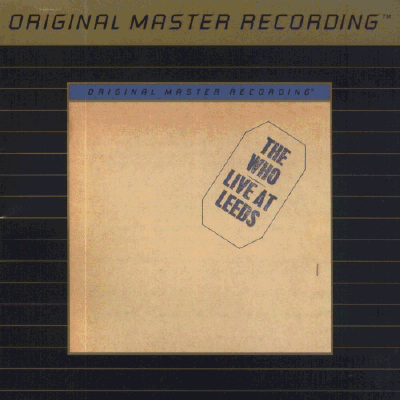
The Who - Live At Leeds (MFSL UDCD 755)


The Who - Live At Leeds
MFSL UDCD -755 (Ultradisc II)

1970-1999
wav-->wv
all covers
cue.log

The strengths and weaknesses of the Who are revealed in all their glory and folly on these two significant remastered releases from the good folk at MFSL. Back in the early '70s, these two albums were pure dynamite; listening to them in the late '90s, I was surprised at how well this music holds up. The main strength of The Who was their boundless energy, embodied most forcefully in the frenzied drumming of Keith Moon, but also realized quite tellingly in the guitar attacks of Pete Townshend and the bass runs laid down by John Entwistle. Their main weakness was their mediocre vocalizing -- for all his straining and posturing, Roger Daltrey was really at best an average vocalist, and he often falls short of his best. Still, these two releases showcase the band at their best, both in live performance and in the studio. For all its energy and inspiration, Live at Leeds still gets dragged down by its vocals; however, Who's Next comes to life with its remastering job and extra cuts. For rock and roll fans, then, this new release of Who's Next is absolutely indispensable. Live at Leeds is also indispensable, but primarily for Who fanatics. Both releases represent MFSL at their finest -- great sound, great liner notes, and great choice of material. -- KWN

Produced by The Who and recorded on Valentine’s Day, 14 February 14 1970 at Leeds University, LIVE AT LEEDS was released in the UK in May 1970 on Track Records (2406 001), as a CD in the 1980s by Polydor (825 339-2) a Polydor remastered CD with additional tracks (527 169-2) in 1995, and finally as a Deluxe Edition in 2001 (Polydor 112 618-2).

It was released simultaneously in the US on Decca (DL 79175), as a CD (MCA MCAD-37000, MFSL UDCD 755), as a remixed CD (MCA MCAD-11215 and a deluxe limited (and numbered) edition that included the paper inserts MCAD-11230) in 1995, and as a Deluxe Edition (E+CD MCA 088 112 618-2) in 2001.

LIVE AT LEEDS was designed to emphasise The Who as a rock band as opposed to opera singers and its packaging was also an antidote to the splendour of TOMMY: a plain buff sleeve roughly rubber-stamped with the band’s name and designed to resemble a bootleg. Within could be found an envelope containing all sorts of facsimile Who ephemera (photos, date sheets, contracts, lyrics) and a record on which there was a handwritten warning that crackles heard throughout were not the fault of your record player. The remastered 1995 CD amended the note to say the crackling noises had been corrected!

LIVE AT LEEDS has undergone two upgrades since it was first released. The first incorporated eight extra songs from the concert, while the second featured the entire concert spread over two CDs, the non-TOMMY songs on CD1 with TOMMY occupying all of CD2. While some would have preferred to have had the concert’s original running order left intact, that would have required ending the first disc somewhere in the middle of TOMMY. This approach keeps the original reason for LIVE AT LEEDS in focus, with TOMMY deliberately set aside.

LIVE AT LEEDS reached #3 in the UK album charts and #4 in the US.

Original sleeve design by Graphreaks.

All songs by Pete Townshend unless otherwise indicated.

The original LP and CD consisted of just six tracks.

1. YOUNG MAN BLUES
(Mose Allison)
Jazz pianist Mose Allison first recorded this blues song in 1957 for his Prestige album BACK COUNTRY SUITE, and it was originally titled simply BLUES. The song was performed during The Who’s early incarnation as The High Numbers in 1964, and was resurrected as YOUNG MAN BLUES in 1968, and routinely used during the TOMMY tours of 1969/70.
2. SUBSTITUTE
The Who’s fourth single, first released in March 1966.
3. SUMMERTIME BLUES
(Eddie Cochran/Jerry Capehart)
First recorded by its writer, Eddie Cochran, in 1958. Other Cochran songs essayed by The Who included C'MON EVERYBODY and the lesser known MY WAY (see ODDS & SODS).
4. SHAKIN’ALL OVER
(Fred Heath)
Written and recorded by Johnny Kidd & the Pirates in 1960. In concert The Who occasionally segued into Willie Dixon’s SPOONFUL and then back again into SHAKIN' ALL OVER for the finale. In fact, they did this at Leeds as the unedited tapes reveal.
5. MY GENERATION
The Who’s third single is extended to 14 minutes after the bass solo into what Pete refers to as ‘The Who Hymn’, incorporating reprised sections from Tommy, including SEE ME, FEEEL ME, improvised blues and R&B, and soloing.
6. MAGIC BUS
Released as a single in September, 1968.

The First Upgrade
The 1995 CD version of LIVE AT LEEDS consisted of 14 tracks. (The two catalogue numbers for the American version represent a regular CD release including a special box set, the size of a 12” album, so that full-size reproductions of the original enclosures could be included.)

The ‘remixed’ or ‘remastered’ CD (depending on what cover came with the CD) interspersed eight songs in their proper order from the concert as follows:

1. HEAVEN AND HELL
2. I CAN'T EXPLAIN
3. FORTUNE TELLER
4. TATTOO
5. YOUNG MAN BLUES
6. SUBSTITUTE
7. HAPPY JACK
8. I'M A BOY
9. A QUICK ONE, WHILE HE'S AWAY
10. AMAZING JOURNEY / SPARKS
11. SUMMERTIME BLUES
12. SHAKIN' ALL OVER
13. MY GENERATION
14. MAGIC BUS


Enlace en comentarios / Link in comments


Etiquetas:

sábado, marzo 08, 2008

Humble Pie - Town and Country (K2 HD)


Humble Pie - Town and Country

1969-2006
Japan K2 HD
VICP-63558
eac.wv.cue.scans

Humble Pie, el grupo creado por el ex Small Faces, Steve Marriott, y el ex The Herd, Peter Frampton, junto al bajista de Spooky Tooth, Gerry Ridley y el batería Jerry Shirley, el mismo año que grabaron su disco debut "As safe as yesterday", presentaronn su segundo trabajo, "Town and country", un esmerado álbum substancialmente de corte acústico que bucea en estilos como el rock, el blues, el country y el folk.

El disco es un muestrario del talento de la banda, con piezas como "The sad bag of shakey Jake", una de las pocas piezas eléctricas del disco obra de un inspirado Steve Marriott o "Light of love", extraordinario tema de aroma psicodélico compuesto por Ridley que cuenta con un espectacular sitar interpretado por Marriott y una esmerada ejecución vocal.

Otras canciones destacadas son la folkie "Every mothers son", de hermosa melodía con un curioso inicio toreril, o "Home and away", una rítmica gema que cierra de forma excepcional este recomendable álbum, en el cual recuperan y endurecen un viejo tema de Buddy Holly & The Crickets titulado "Heartbeat".

HUMBLE PIE Town And Country (2006 Japanese exclusive issue limited edition 13-track 'K2 High Definition Coding' CD album originally released in 1969 on the Immediate label, the group's 2nd album saw them pursue a more acoustic leaning, with Peter Frampton supplying more guitar as Steve Marriott moved over to keyboards, includes 2 BONUS TRACKS, superbly presented in mini LP-style card sleeve with obi strip - sealed!)


Anyone who thinks of Humble Pie solely in terms of their latter-day boogie rock will be greatly surprised with this, the band's second release, for it is almost entirely acoustic. There is a gently rocking cover of Buddy Holly's "Heartbeat," and a couple of electrified Steve Marriott numbers, but the overall feel is definitely more of the country than the town or city. "The Sad Bag of Shaky Jake" is a typical Marriott country ditty, similar to those he would include almost as a token on each of the subsequent studio albums, and "Every Mother's Son" is structured as a folk tale. On "The Light of Love," Marriott even plays sitar. Peter Frampton's contributions here foreshadow the acoustic-based music he would make as a solo artist a few years later. As a whole, this is a crisp, cleanly recorded, attractive-sounding album, totally atypical of the Humble Pie catalog, but well worth a listen.


No-one packages a CD album quite like the Japanese. Known as a culture for elaborate and excessive packaging, their approach to the CD album is no exception. From the visual delights of the artwork and packaging, to the content itself, you will without doubt get your money's worth here. The inclusion of the famous 'obi-strip' not only adds a uniquely intriguing aspect, but is also a great marketing tool for the Japanese labels. The term 'obi-strip' is derived from the name of the piece of wide fabric - the obi - that a geisha woman wears around her waist over the traditional Kimono dress. An amazing amount of information is packed onto this little wraparound piece of paper, often noting special tracks, concert dates, discography information and release anniversaries. And, as this information is intended to be read in the home market, it’s all printed in Japanese kanji and ~kana script! Whilst they are safely sealed on new release CD’s they are often discarded once opened, so they should be considered a real bonus when intact on out-of-print CD’s.

In recent years we have seen the obi-strip occasionally replaced with a sleeve sticker, no less attractive and equally unique to the Japanese pressing. Japanese CD albums often benefit from extra music and new video-style content, to further entice the Japanese public to buy their native release and not an import. Non-album tracks and exclusive mixes often feature and there are a huge amount of 'Japan-Only' releases that do not have an equivalent release elsewhere in the world. Japanese pressings will nearly always include a lyric booklet or fold-out lyric sheet. These are dual-language, printed in both the ~kana script and in English, the latter often having some wonderful mis-translations!

1. Take Me Back
2. Sad Bag of Shaky Jake
3. Light of Love
4. Cold Lady
5. Down Home Again
6. Ollie Ollie
7. Every Mother's Son
8. Heartbeat
9. Only You Can See
10. Silver Tongue
11. Home and Away
12. 79th Street Blues - bonus track
13. Greg's Song - bonus track

Enlace en comentarios / Link in comments

Humble Pie - Natural born boogie 1968

Etiquetas:

Al Stewart - Year of the cat (MFSL)


Al Stewart - Year of the cat (MFCD 803)
MFSL Alumunium


Un relajante disco de predominio acústico, con textos de esencia literaria y referencias históricas, pasajes memorativos y rica imaginería de empleo figurativo.
La sofisticada producción de Alan Parsons, en vez de asfixiar la escritura, confiere al album un sonido elegante, fresco y dúctil.

Entre sus composiciones pop y soft-rock de reminiscencias folk, casi en su totalidad sin tacha en sus melodías y en su sedosa ejecución vocal, destaca "Lord Grenville", canción que recupera en clave poética la historia real de Richard Grenville, un marino británico en lucha contra la armada española, desarrollada con un sonido que no se aleja demasiado de algunos cortes encontrados en el "Hunky Dory" de David Bowie.

Otras de las mejores piezas del album son "On the border", extraordinario tema con resonancias españolas, la dylaniana "Sand in your shoes", "Broadway hotel", poseedora de una sombría atmósfera acentuada por un clavicordio, un expresivo violín y un desarrollo turbador, al igual que la simbólica "On the stage before", de iterativo ritmo y espectral clima.
La obra maestra es "Year of the cat", una canción que atrapa desde su piano inicial hasta su conocido solo de saxo, bellamente arreglada y con una letra que epitomiza bien el carácter lírico de este ensoñador y excelente Lp.


This, Stewart's first platinum album, was the one that cemented Stewart in the annals of pop-music history (the album hit Billboard's Top 5) and made him a huge international star. Producer Alan Parsons' formula from Modern Times, mixing Stewart's historically themed folk-rock pieces with jazz conventions (like the unforgettable Phil Kenzie saxophone break in the title song) and absolute gorgeousness (Peter Wood's heartstoppingly lovely "YOTC" piano intro), worked like the proverbial charm when it came to electrifying music listeners and encouraging them to part with their dollars and pounds. Why? Yes, the combination of the sophisticated Parsons touch with Stewart's folk-rock foundation piqued interest, but in the end, Stewart won appreciators through his unforgettable stories and songs: the arousing title track, the sad "Broadway Hotel," and "Flying Sorcery," the first of Stewart's songs to focus on the exploits of pilots. At the time, Billboard hailed YOTC for its "exceptionally well-arranged songs that are progressive without being pretentious. ... This set was recorded at the Abbey Road Studios in London, and through heavy use of strings has a symphonic, almost classical beauty." Extremely noteworthy is the first appearance of guitarist Peter White, then a sessionist hired to play Spanish style guitar for the swirling, intriguing Top 20 hit "On the Border"; his long, fruitful collaboration with Stewart began on Year of the Cat.


MFSL Original Recording Remastered (Silver Edition)


Enlace en comentarios / Link in coments

Etiquetas: